Water & Wastewater
 | | | |
Water Supply and Water Quality
Major issues facing Southern New Castle County include that Southern New Castle County water supplies are currently provided exclusively from groundwater supplies, that new development and the Artesian Water Company pipeline across the C and D canal continue to exert pressure on limited groundwater resources, and that continued and accurate monitoring of water quality and water availability is essential to the public health. (Future Link to Water Supply Coordination Council and other sites to vigilantly keep tract off to protect our waters).
NEW INFO * * * Riparian Buffers * * * NEW INFO
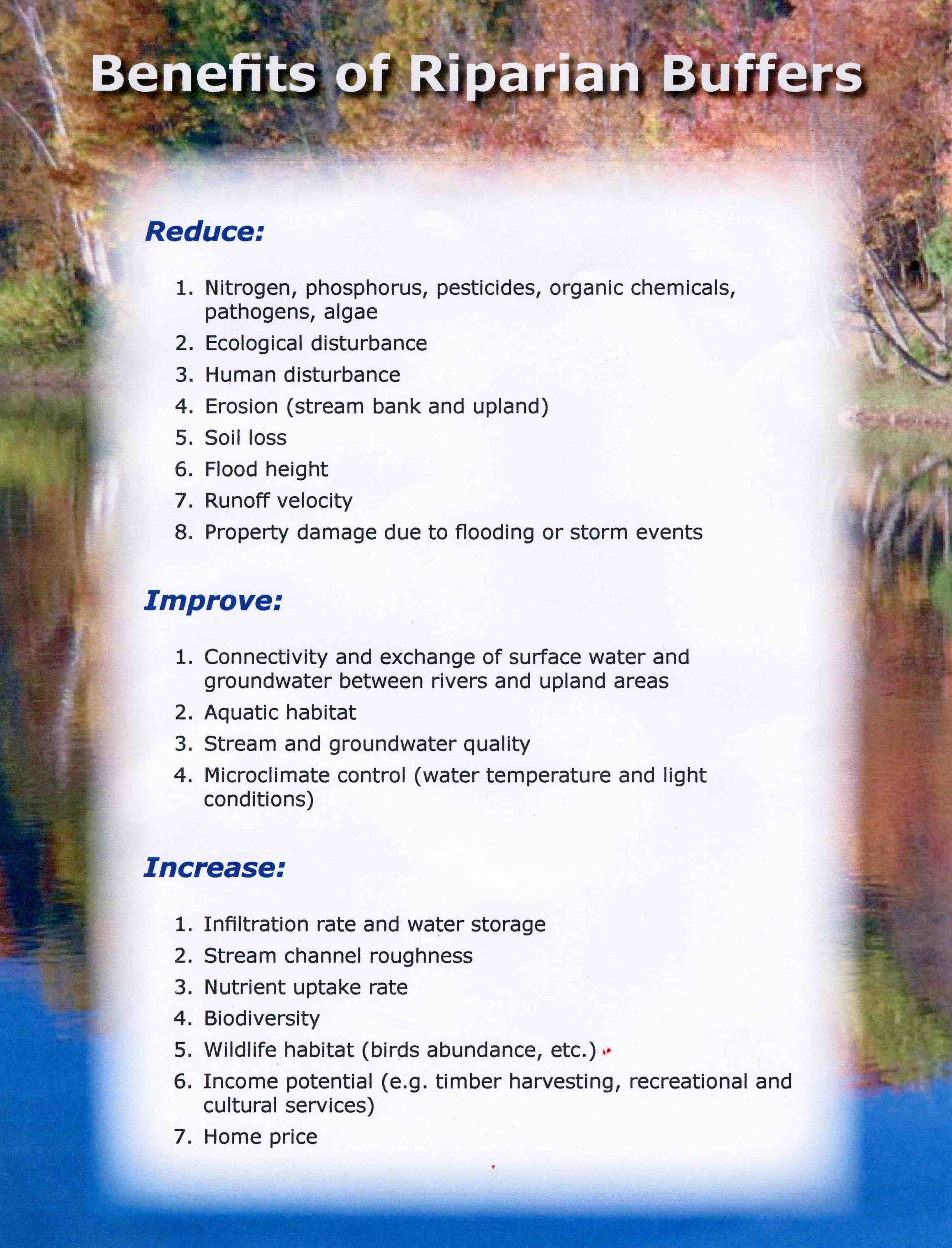
Due to the vital importance riparian buffers play in the protection of our
streams, wetlands, wildlife habitat and drinking water, the SNCCA feels they should be at least 100 feet.
We also believe that there needs to be a statewide law to protect riparian buffers.
Riparian Buffers Fact Sheet
There a many scientific reasons for this recomendation. A few of the key points are
outlined below:
Why 100 Foot Minimums?
The Science is Clear. The Benefits are Clear.
- Ninety Percent (90) of Delaware's waterways have been identified as "impaired".
Delaware Impaired/Polluted Waters (Click Here)
- Neighboring states have successfully enacted legislation requiring 100 foot minimums.
New York, Massachusetts, Rhode Island, Connecticut, and Maryland among them.
Examples State Buffer Laws (Click Here)
- Nutrient Removal: ". . . experts who commonly work with the 100 foot buffer zone set
by the Massachusetts Wetlands Protection Act are increasingly finding that it is
insufficient since many pollutants routinely travel distances far greater than
100 feet with nitrate-nitrogen derived from septic systems moving distances of
greater than 1000 feet. Research indicates that the adoption of 100 foot buffer
widths for Connecticut riparian zones will assist with the nutrient assimilation;
albeit, complete removal of all nutrients may not be achieved. "Utilization of
100 Foot Buffer Zones To Protect Riparian Areas in Connecticut by Brian D. Murphy,
Technical Assistance Biologist, Inland Fisheries Divison
Nutrient Removal (Click Here)
- Why a fixed width? "A fixed buffer width is the easiest to administer.
However, care must be taken to select the appropriate width for the resources
you are targeting. Studies unanimously support the conclusion that buffer
efficiency at filtering out pollutants increased with width. Therefore,
we believe it is necessary to make a fixed buffer width wider than the
average minimum recommendation of 100ft." -Yale School of Forestry and
Environmental Studies, April 2005
Why a Fixed 100ft. Buffer Width (Click Here)
LETTER ON NEED FOR STATEWIDE RIPARIAN BUFFERS FROM SNCCA VICE PRESIDENT:
November 13, 2006
The Southern New Castle County Alliance (SNCCA)supports the efforts of the citizens of Sussex County and the citizens of the State of Delaware in calling for statewide legislation mandating a minimum of 100 foot buffers along all Blue Line Streams, Tidal Wetlands and Tidal Waters. We also call for statewide legislation establishing minimum buffer requirements around Fresh Water Wetlands.
The Inland Bays buffer requirements are of far greater than local significance. Riparian resources are every bit as important statewide as our tidal wetlands, subaqueous lands, and our fragile Coastal zone. These resources were wisely given Statewide legal protection. Based on the science, we must add Statewide legislation to protect our fragile waters.
We in New Castle County have some of the strongest protections for riparian buffers, yet we still struggle to protect and improve the quality of our waters. It is confusing for those who want to develop. If the goal is to establish a business friendly environment, then we must have consistency in the regulatory requirements across the State. Establishing 100 foot minimums statewide would create that consistency, and assist our local government agencies with this environmental protection effort, especially since so few have environmental experts on staff.
The continued failure to establish 100 foot minimum buffers, and to complete the needed resource protection job started in the 1970's is now one of the largest threats to the ecological integrity of Delaware's fragile coastal resources. The attack of those profiting from the unconstrained destruction of green infrastructure, which includes the ecological services provided by riparian buffers, is nothing new to Delaware. In 1974, a pamphlet created by the Building and Construction Trades Council, headed by Toby Ryan, insisted that the Coastal Zone Act should be revised. Mr. Ryan wanted to rewrite the CZA with an amendment that would say "industry should be allowed in the coastal zone as long as it meets any pollution standards the state wants to set."Ryan made the assertion that the Delaware economy would suffer without making such allowances for development.
The Philadelphia Inquirer responded to the Building and Construction Trades Council President with the following headline: "DESTROY DELAWARE TO SAVE IT?" The editorial went further; "But what about fishing and tourism? Aren't those industries, too? And what about space and scenery and solitude? Aren't those values to be protected too? Must every square inch of America's dwindling open shoreline be sacrificed to industrial growth?
The question it seems to us, is not whether Delaware will survive, for it will, but how its citizens will live. To destroy forever the livability of a place is not our idea of the way to save it."
The efforts of the development industry in Delaware today are no different than the efforts of the Building and Construction Trades Council in 1974. The difference in Delaware today is that there is far less land left to protect and far greater damage done to our waters. Delaware also seems to lack the leadership necessary to protect the remaining critical environmental resources of statewide importance, like riparian buffers and freshwater wetlands. Delawareans deserve clean water to drink and clean water to recreate in and on. Statewide legislation establishing 100 foot minimum buffers would go a long way to promote and protect Delaware's waters. It is far cheaper to protect these resources than it is to restore them. It seems irresponsible for our public agencies to spend so much money "restoring" these ecological systems, when we have not taken the minimum steps necessary to protect the high quality buffer areas. This is a bad public policy, that appears to be the result of the evasion of responsibility by public officials.
We call upon Governor Minner, architect of "Liveable Delaware", and Secretary Hughes to support 100 foot buffers Statewide. Anything less should be considered an act of environmental cowardice.
We echo the Inquirer's sentiments-"to destroy forever the livability of a place is not our idea of the way to save it."
Leann H. Ferguson
Executive Vice President
Southern New Castle County Alliance
Wastewater
The planned New Castle County Southern Sewer Service expansion (Water Farm 2) is too large and not required to meet the population growth in Southern New Castle County due to the Annexation and growth in Middletown and Smyrna with wastewater infrastructure. This project is not needed and is not a financially viable project based on projected housing needs of the Delaware Population Consortium.
Download White Paper on Southern Sewer Service Area
SSSA Expansion Discussion 033004.PDF
(29KB)
New Castle County is also considering additional treated wastewater discharges to the Appoquinimink River or the Delaware River as a cost saving technique. This is taking us in the opposite direction that we need to be heading in order to protect our water quality and the healthy conditions needed to support the fish and wildlife resources we desire for our rivers and streams.
Action to be Taken:
Contact your legislators and request a "Sewer Summit" that engages the public and government officials to better coordinate sewer service in Southern New Castle County.
Link to Index of Delaware Elected Officials/Contact Information Links
(http://www.state.de.us/gic/contacts.htm)
Drainage and Flooding
Explosive development in Southern New Castle County has created numerous runoff and flooding conditions that did not exist in the past. (future link to photos and descriptions of problems at various sites.) Property values are being adversely impacted as poor planning exacerbates these conditions.
The Governor created a Surface Water Management Task Force in an attempt to address this problem. The list of Task Force members heavily represents the development industry and political insiders with no real representation from the affected citizens. (future link to task force site). They are recommending a "back door tax" by creating a Storm Water Utility that would manage such conditions.
Action to be taken:
1. Document conditions you may be aware of.(photos, times, dates, locations, etc.)
2. Contact your elected officials and insist on planning on a "watershed" basis rather than a site specific management plan.
Link to Index of Delaware Elected Officials/Contact Information Links
(http://www.state.de.us/gic/contacts.htm)
| | | | |
|
|
©all rights reserved, Southern New Castle County Alliance
|